What a COP actually is
COP stands for Conference of the Parties. It is not an event somebody convenes when the climate is in the news, it is a clause in a treaty signed in 1992 that obliges the countries who signed to meet every year.
In November I go to my first COP. Before that I gave myself the job of understanding how the thing works, and what surprised me was how basic my own confusion turned out to be.
COP stands for Conference of the Parties. The Parties are the countries that signed the UN climate treaty, the UNFCCC, at the Rio Earth Summit in 1992. That treaty contains a clause that explains everything that came after: the Parties have to meet every year to review how it is being implemented. That annual meeting is the COP. It has happened every year since 1995, when the first one took place in Berlin, and it happens whether or not the climate is in the news that year.
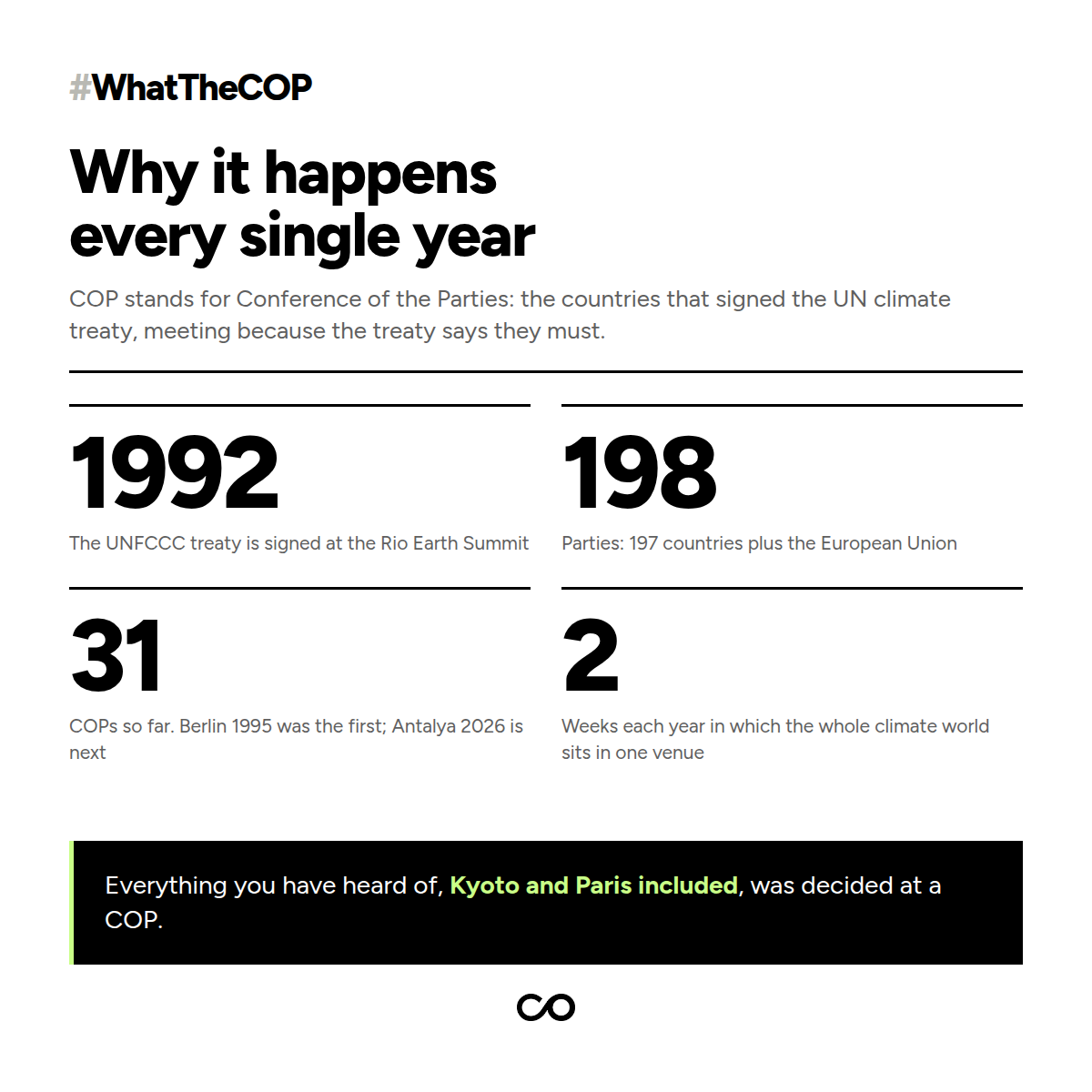
Today there are 198 Parties, 197 countries plus the European Union. Almost every country on Earth (there are 195 in total, by the usual count). That number is what makes COP different from any other climate meeting: nobody else gets everyone in the room.
Every treaty has its own COP
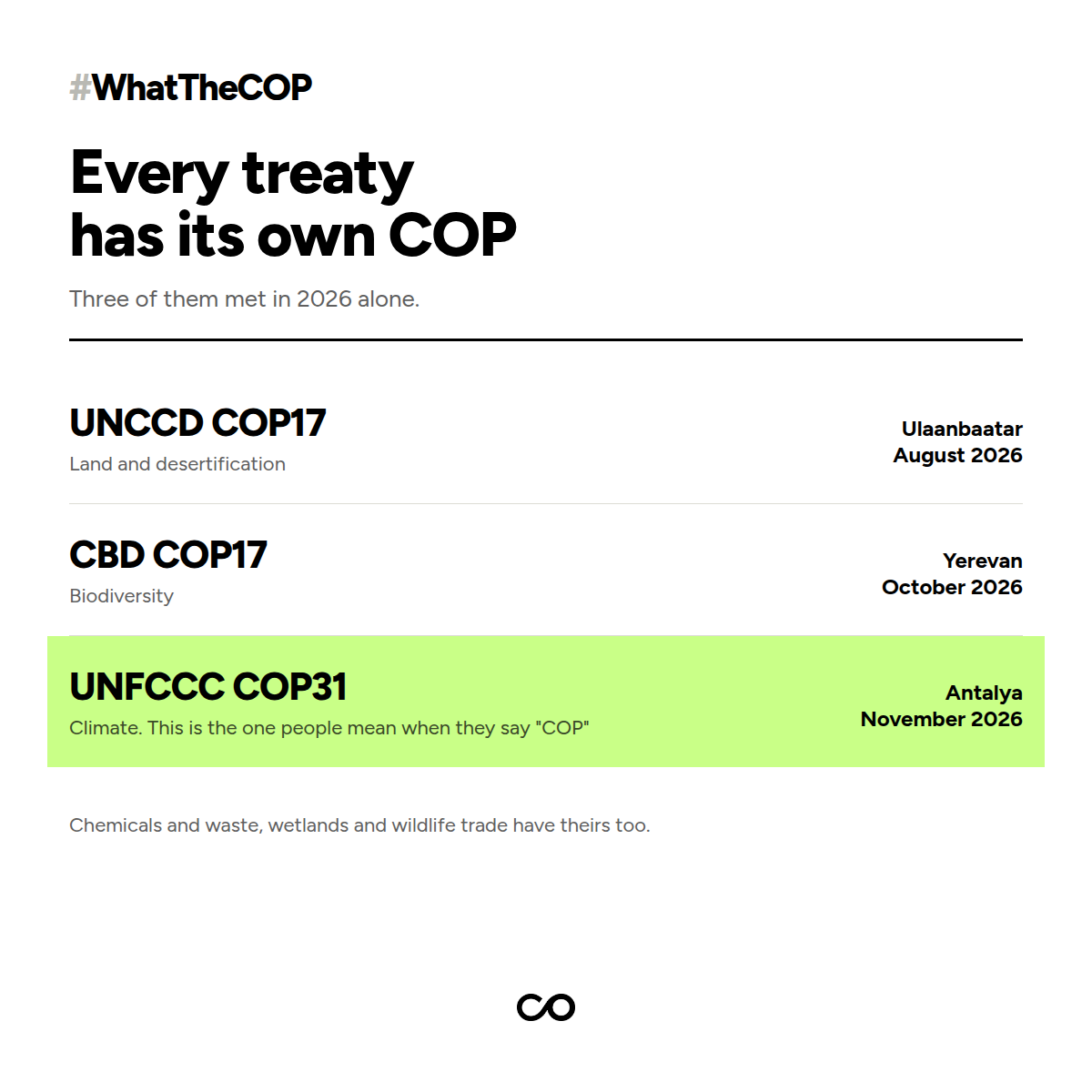
Something that took me a while to place: COP is not the name of an event. Every UN treaty has its own Conference of the Parties, and three of them met this year. In August the land and desertification COP17 was in Ulaanbaatar. In October the biodiversity COP17 meets in Yerevan, three weeks before Antalya. Chemicals and waste, wetlands and wildlife trade have theirs too. When everyone says COP in November, they mean the climate one.
The COPs you already know
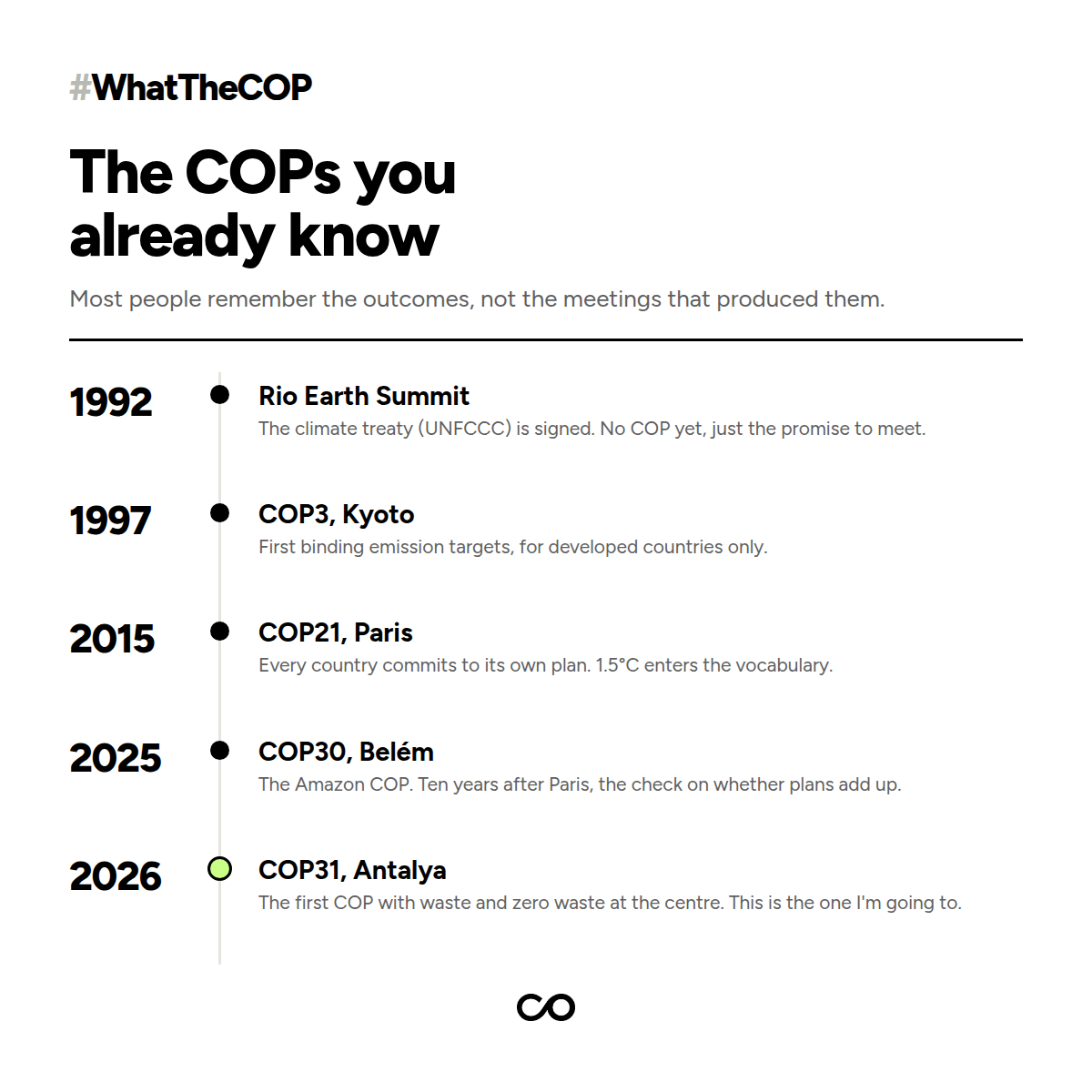
You already know several climate COPs, you just do not call them that. Kyoto in 1997 was COP3, the first time developed countries accepted binding emission targets. Paris in 2015 was COP21, where every country committed to its own plan and 1.5°C became the number everybody repeats. Belém last year was COP30, ten years after Paris and the moment to check whether all those plans add up. They do not, yet. Antalya in November is COP31.
Between Kyoto and Paris something changed that is worth understanding, because it explains the COP we have today. Kyoto worked from the top down: targets were assigned, they were legally binding, and they applied only to developed countries. It was elegant on paper and it struggled in practice. The United States signed it and never ratified it, and a treaty that leaves out the world's largest emitters of the time has a ceiling built into it.
Paris flipped the design. Instead of assigning targets, it asked every country to put forward its own plan, developed and developing alike, and to come back and improve it over time. Weaker in obligation, far wider in coverage, and that trade is the reason almost every country on Earth is in the room today. It also means the hard part moved. With Kyoto the fight was over who gets which number. Since Paris, the fight is over whether anyone is actually doing what they said.
How far a COP decision goes
People often say COP is where nothing gets decided. Kyoto and Paris were decided at a COP, and so were the rules that oblige countries to report their emissions. The confusion is about scope.
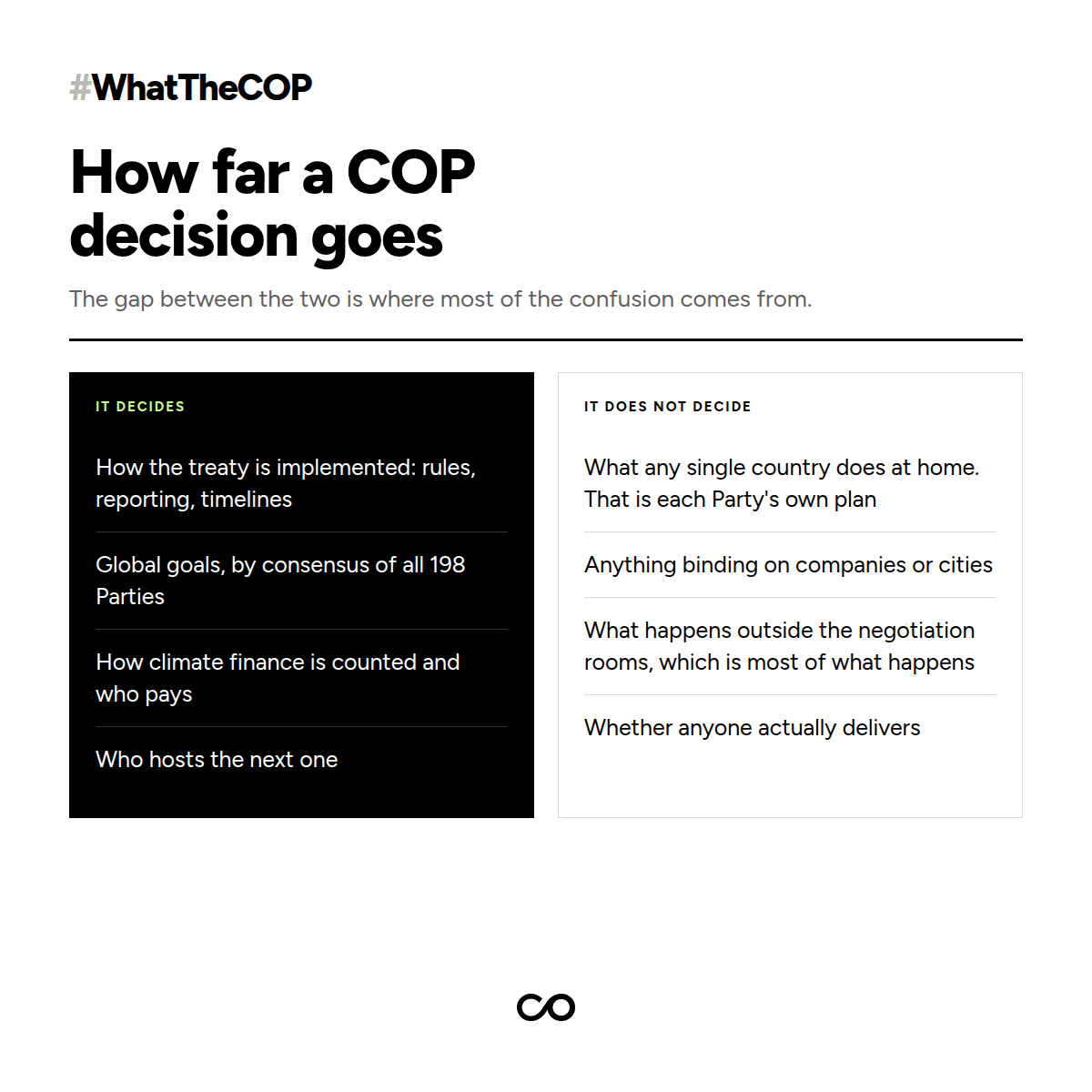
A COP decides how the treaty gets implemented, which means rules, reporting and timelines. It sets global goals by consensus of all 198 Parties (in my view this is a virtue and a defect at the same time: consensus is what gives a decision real weight, since nobody can say later that it was imposed on them, and it is also why a single country can hold a text hostage until four in the morning on the last day). It decides how climate finance is counted and who pays. And it decides who hosts the next one.
It has no power over what any country does at home, because that is each Party's own plan. Nothing it agrees is binding on a company or a city. And it cannot make anyone deliver. A COP produces commitments. Delivery happens the other fifty weeks of the year, somewhere else.
That gap is the interesting part, and it is why I am writing this. The negotiation rooms are the smallest part of a COP. Belém last year had 42,618 people on site, and in the registration list only about one in five of them belonged to a national delegation. The rest were companies, cities, investors, NGOs, researchers and press, and they were there because a treaty on its own does not build anything.
- COP
- Conference of the Parties. The annual meeting of the countries that signed a UN treaty.
- UNFCCC
- UN Framework Convention on Climate Change. The climate treaty signed in Rio in 1992, and its secretariat in Bonn.
- Party
- A country that has signed and ratified the treaty. There are 198, counting the European Union.
- NDC
- Nationally Determined Contribution. The climate plan each country writes for itself under the Paris Agreement.