How the Action Agenda is organised
The Action Agenda is the part of a COP that is not a negotiation. It sorts everything into six Axes, thirty Activation Groups underneath them, and Plans to Accelerate Solutions underneath those, which is where the work becomes concrete.
The Action Agenda is the part of a COP I work in, and for months I could not explain it to anyone in under five minutes. This is the version I wish someone had handed me when I started.
Why it exists at all
Paris, in 2015, did two things. Countries committed to their own national plans. And the same decision text created two High-Level Climate Champions, whose job was to mobilise everyone who is not a country (companies, cities, regions, investors, civil society), because the national plans on their own were never going to add up.
Eleven years later that gap is the whole story. On 2 September this year UNEP published a report called Limiting Overshoot. Its conclusion is that the world crosses 1.5°C within the next few years, and that even the most optimistic scenario peaks around 1.8°C. The route back runs through overshoot, peak and decline: cut hard now, go net-negative later, adapt to what arrives in the meantime.
That is the context the Action Agenda operates in. The negotiations set direction for governments. Emissions come down when someone actually changes how a city collects its waste, how a mill makes its steel, how a utility connects a household. The Action Agenda is the machinery built to accelerate that kind of change, and it is the only part of a COP most organisations will ever be able to touch.
Where it comes from
The Champions role was created by the Paris decision in 2015. The Marrakech Partnership for Global Climate Action followed at COP22 in 2016 as the framework to organise all of it. At COP30 in Belém a new five-year vision was launched, running to 2030, and 2026 is the first year under it. (The governance terms of reference came out in August, which tells you how recently the current shape was settled.)
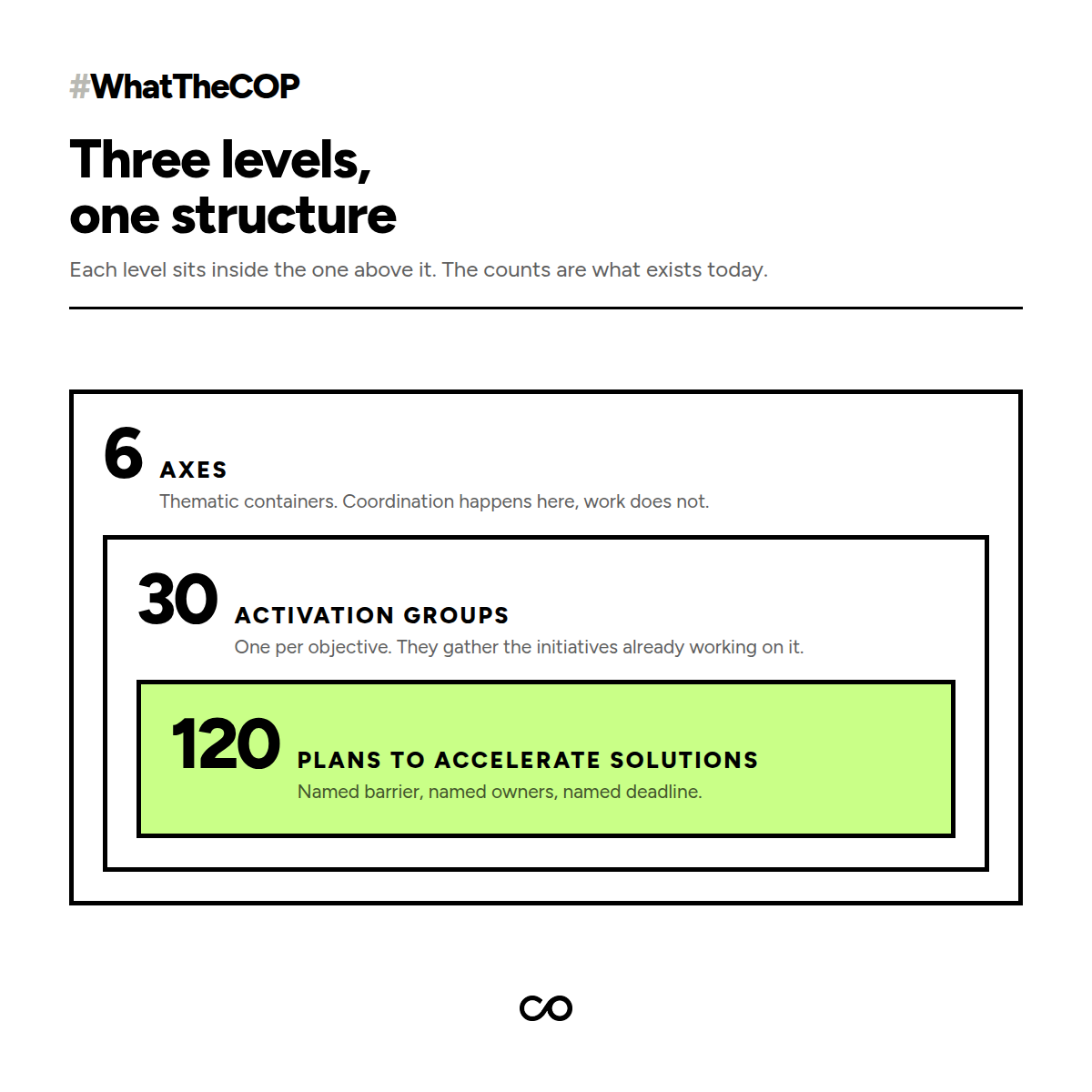
Level one: six Axes
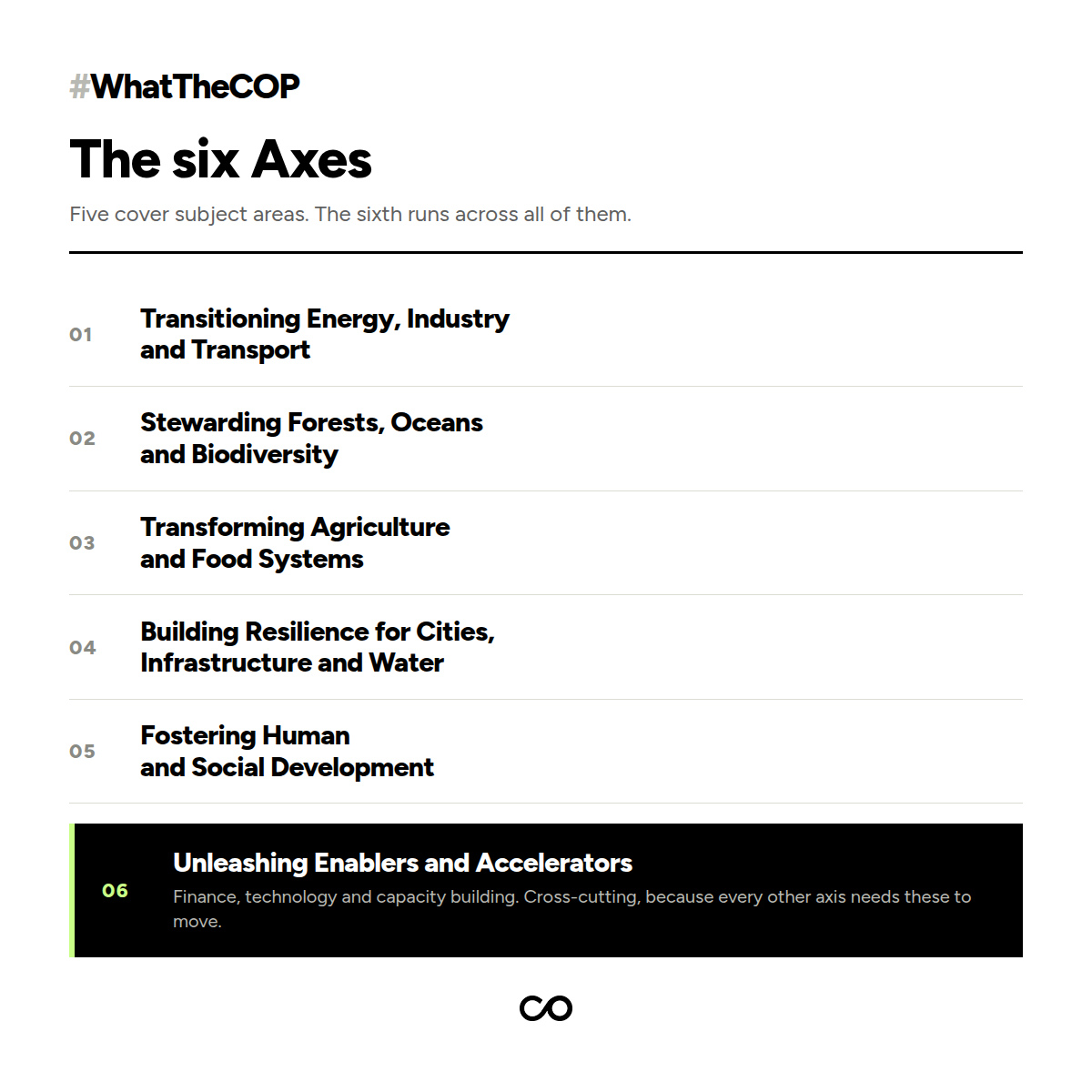
Everything is sorted into six thematic areas (think of them as ministries, it is simply how the subjects get divided up).
- Transitioning Energy, Industry and Transport
- Stewarding Forests, Oceans and Biodiversity
- Transforming Agriculture and Food Systems
- Building Resilience for Cities, Infrastructure and Water
- Fostering Human and Social Development
- Unleashing Enablers and Accelerators, including Finance, Technology and Capacity Building
The first five cover subject areas. The sixth one is cross-cutting and works across all the others, because finance, technology and capacity building are what every axis needs in order to move. The Axes are containers. Coordination happens at this level, work does not.
Level two: thirty Activation Groups
Under the six Axes sit thirty Activation Groups, one for each of the thirty objectives the Action Agenda has set itself. An Activation Group takes the initiatives, coalitions and practitioners already working on its objective and puts them around one table. More than 400 existing initiatives were sorted into them. They all held their first meetings in January and meet four times before Antalya.
If you are trying to work out where your organisation fits into a COP, this is the level to look at.
Level three: Plans to Accelerate Solutions
Under the Activation Groups sit the PAS, Plans to Accelerate Solutions, and this is where the work becomes concrete. A PAS starts from one question: what is stopping this solution from scaling today? It names the barrier (policy, finance, delivery, or some combination of the three), then names who does what, by when. Every PAS is hosted by an organisation, and the host is always a non-profit.
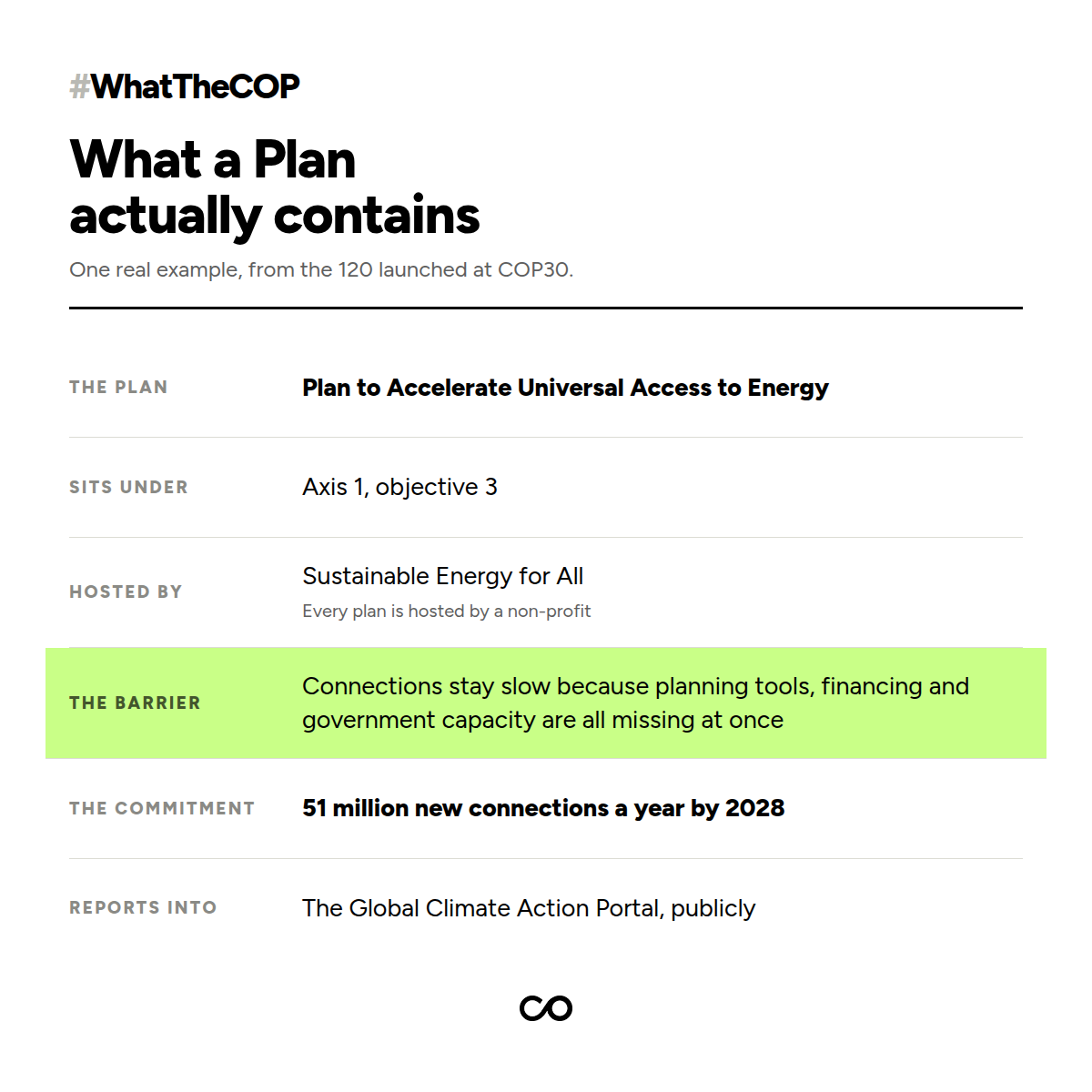
One example, so it stops being abstract. The Plan to Accelerate Universal Access to Energy sits under Axis 1, objective 3, and is hosted by Sustainable Energy for All. The barrier it identified is that connecting households stays slow because planning tools, financing facilities and government capacity are all missing at the same time, so the plan works on the three together. The commitment is 51 million new electricity connections a year by 2028.
120 plans were launched at COP30, covering buildings, power grids, health, water access, steel and fertiliser among others. By the middle of this year 82 per cent of the plan leads had reported progress. 91 per cent involve companies, 39 per cent involve national governments, 24 per cent involve local and regional authorities.
Where the reporting goes
Every PAS has to report, and it reports into the Global Climate Action Portal (which everyone in the process still calls NAZCA, its original name from COP20 in Lima in 2014, Non-State Actor Zone for Climate Action). It is public, and anyone can look up what an initiative committed to and what it has delivered since.
In 2025, 189 initiatives reported results into it, six times as many as the year before, and 157 of them reported against the enhanced indicators for the first time. That shift from announcement to reporting is the part of the Action Agenda that has changed most.
Where waste sits in all this
Objective 15, under Axis 4, Building Resilience for Cities, Infrastructure and Water. That placement tells you how the system reads waste. It sits next to buildings, mobility and water, which shapes who is in the room when it comes up: mayors, utilities, urban planners, infrastructure financiers.
And here is this year's change. Objective 15 was Solid Waste Management. It is becoming Zero Waste and Circularity, at the push of Samed Ağırbaş, the COP31 High-Level Champion.
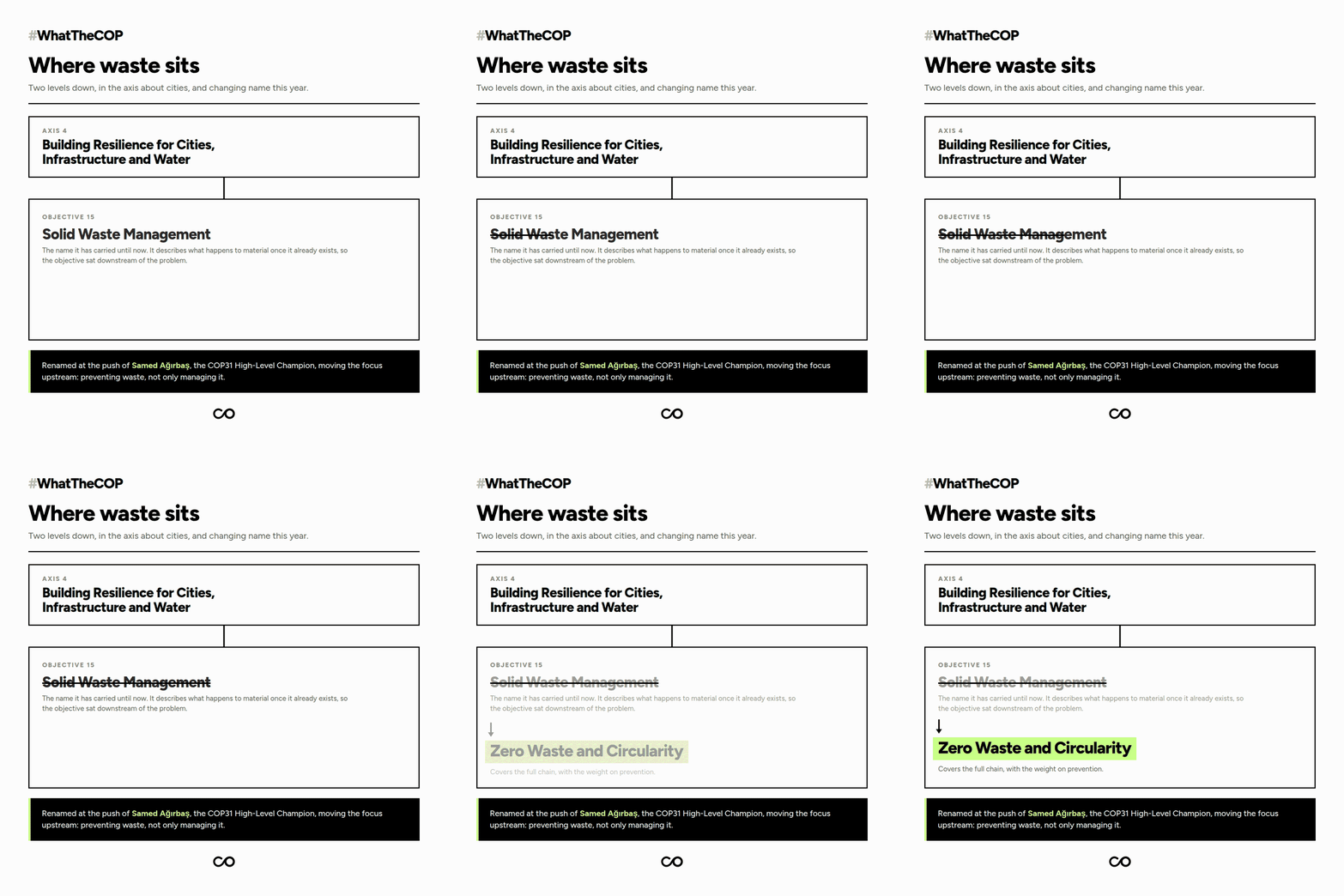
The rename matters more than it sounds. Solid waste management describes what happens to material once it already exists, so the whole objective sat downstream of the problem. Zero waste and circularity covers the full chain and puts the weight on prevention, which is where the climate value concentrates and where almost no infrastructure exists yet.
How to actually get in
Find the objective your work maps onto. Find its Activation Group. Then find out who hosts the PAS you care about, because the host is the one who decides what the plan needs and who comes in, so that is the door. From there, look at whether there is a piece of delivery you can take on, or whether the plan you need has not been written yet.
That path is open to organisations that will never have a seat in the negotiating room, which is almost all of us.
- Action Agenda
- The part of a COP that is not a negotiation, where companies, cities, regions and investors bring commitments.
- Axis
- One of six thematic areas the Action Agenda is divided into. The plural is Axes.
- Activation Group
- One of thirty working groups, one per objective, that gathers the initiatives already working on it.
- PAS
- Plan to Accelerate Solutions. A plan that names a barrier and who will remove it, by when. Always hosted by a non-profit.
- NAZCA
- Non-State Actor Zone for Climate Action, the original name of the Global Climate Action Portal, from COP20 in Lima in 2014.
- Marrakech Partnership
- The framework created at COP22 in 2016 to organise climate action by everyone who is not a country.