Who is who at a COP
A COP is two events happening at once under the same roof. The negotiations, where governments move by consensus. And the Action Agenda, where companies, cities and investors bring voluntary commitments.
A friend asked me last week what I am actually going to be doing at COP31. I started answering and realised I needed to draw him a map of the room first.
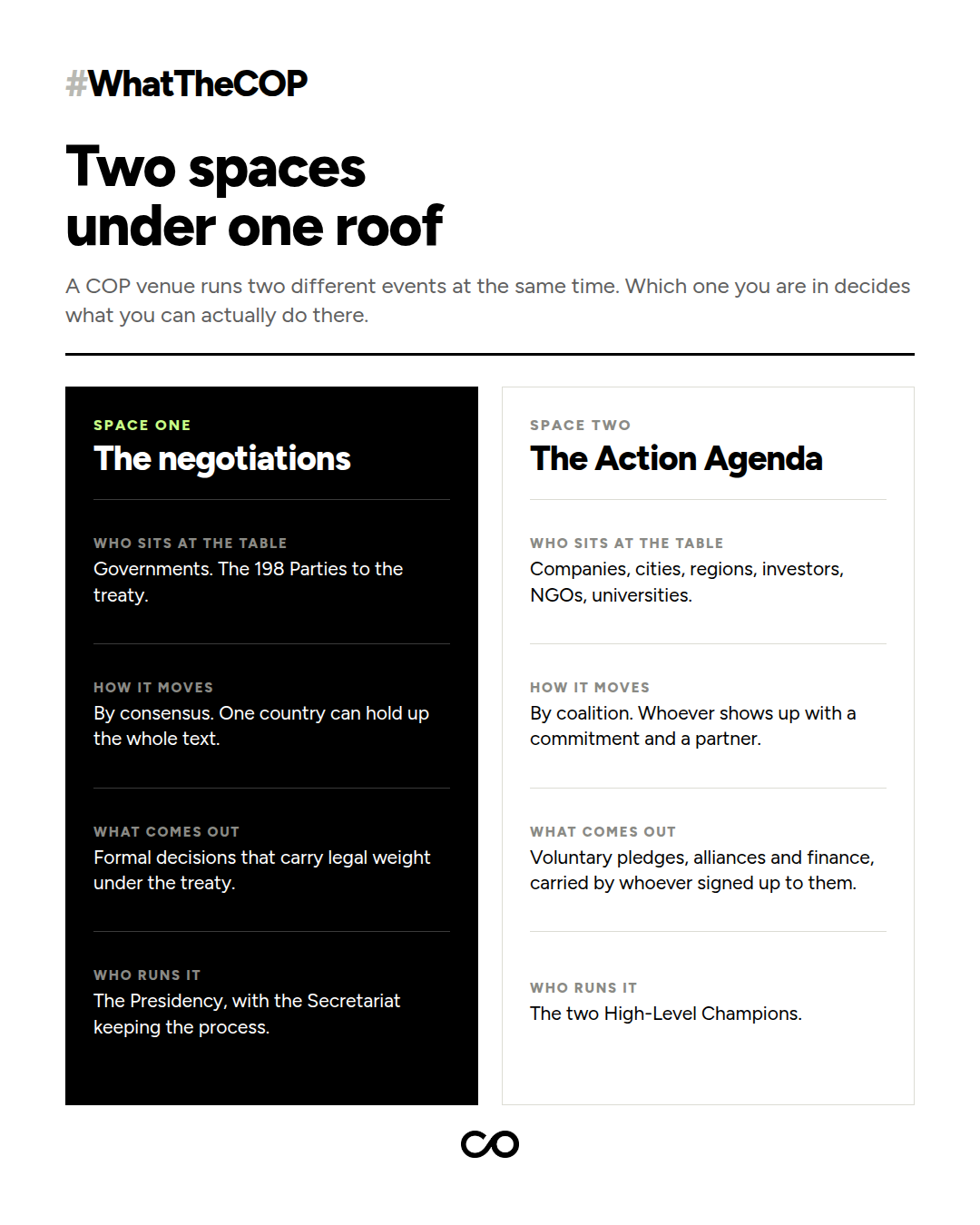
Two spaces under one roof
The negotiations are governments, the 198 Parties. They move by consensus, which means one country can hold up an entire text. They produce decisions with legal weight under the treaty, and they are run by the Presidency with the Secretariat in charge of process.
The Action Agenda is companies, cities, regions, investors, NGOs and universities. It moves by coalition. It produces voluntary commitments, alliances and finance, and it is run by the two High-Level Champions. Different tables, different rules, same building.
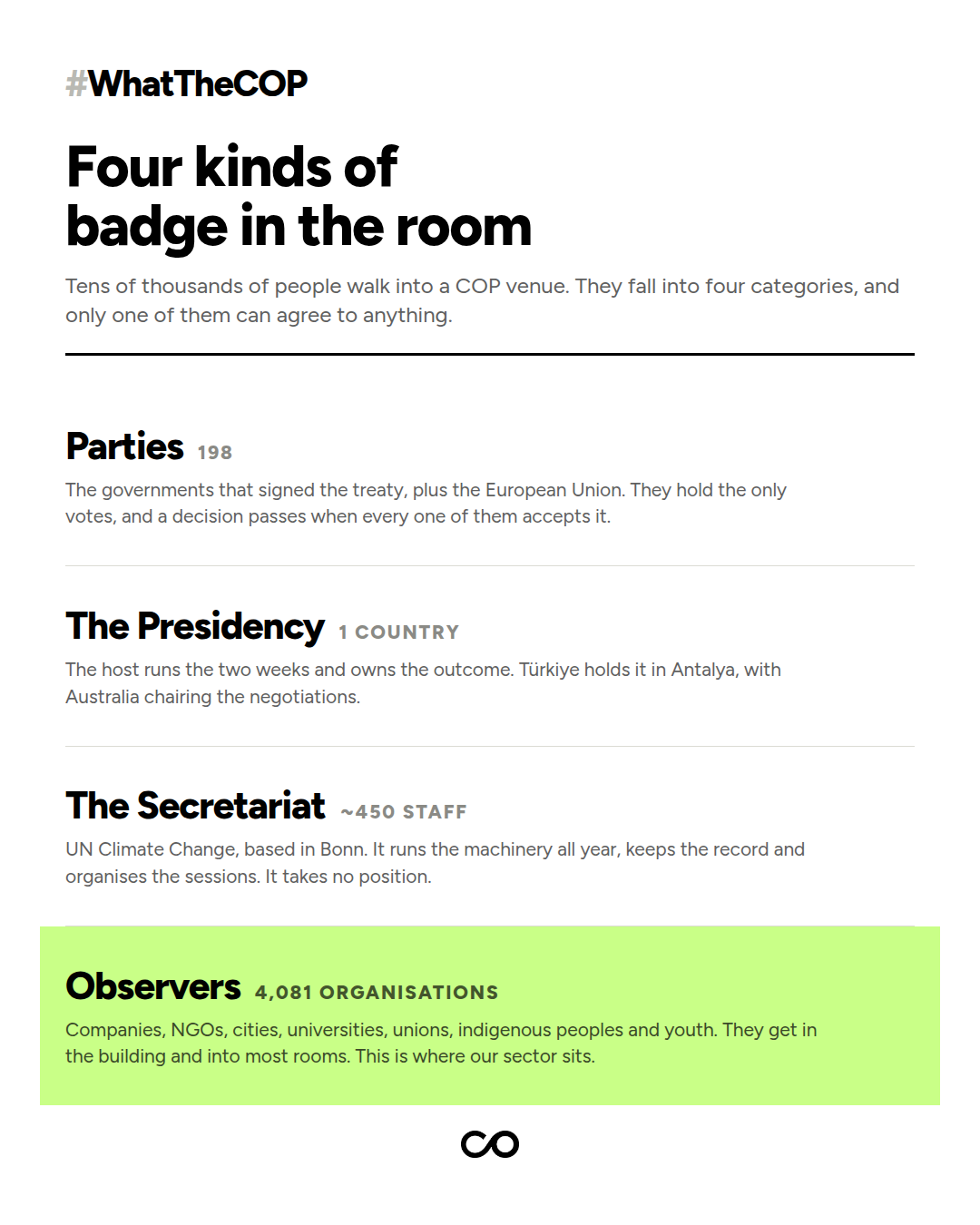
Four kinds of badge in the room
- Parties, 198. The governments that signed the treaty plus the European Union. They hold the only votes, and a decision passes when all of them accept it.
- The Presidency, one country. Türkiye at Antalya, with Australia chairing the negotiations.
- The Secretariat, around 450 staff. UN Climate Change, based in Bonn. It takes no position.
- Observers, 4,081 organisations. Companies, NGOs, cities, universities, trade unions, indigenous peoples and youth.
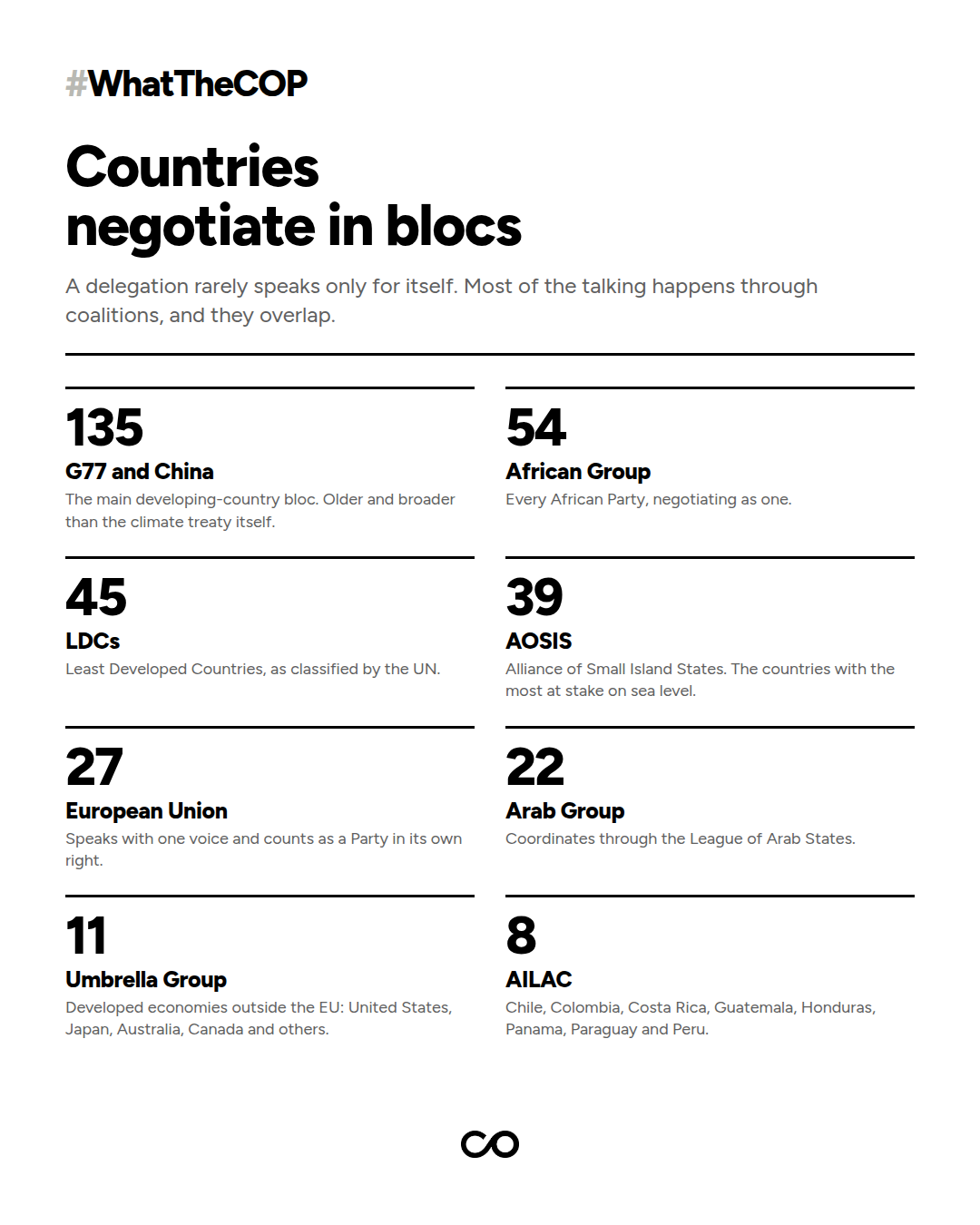
Countries negotiate in blocs
Countries almost never negotiate alone. G77 and China has 135 members, the African Group 54, the Least Developed Countries 45, AOSIS (the small island states) 39, the European Union 27, the Arab Group 22, the Umbrella Group 11, and AILAC 8: Chile, Colombia, Costa Rica, Guatemala, Honduras, Panama, Paraguay and Peru.
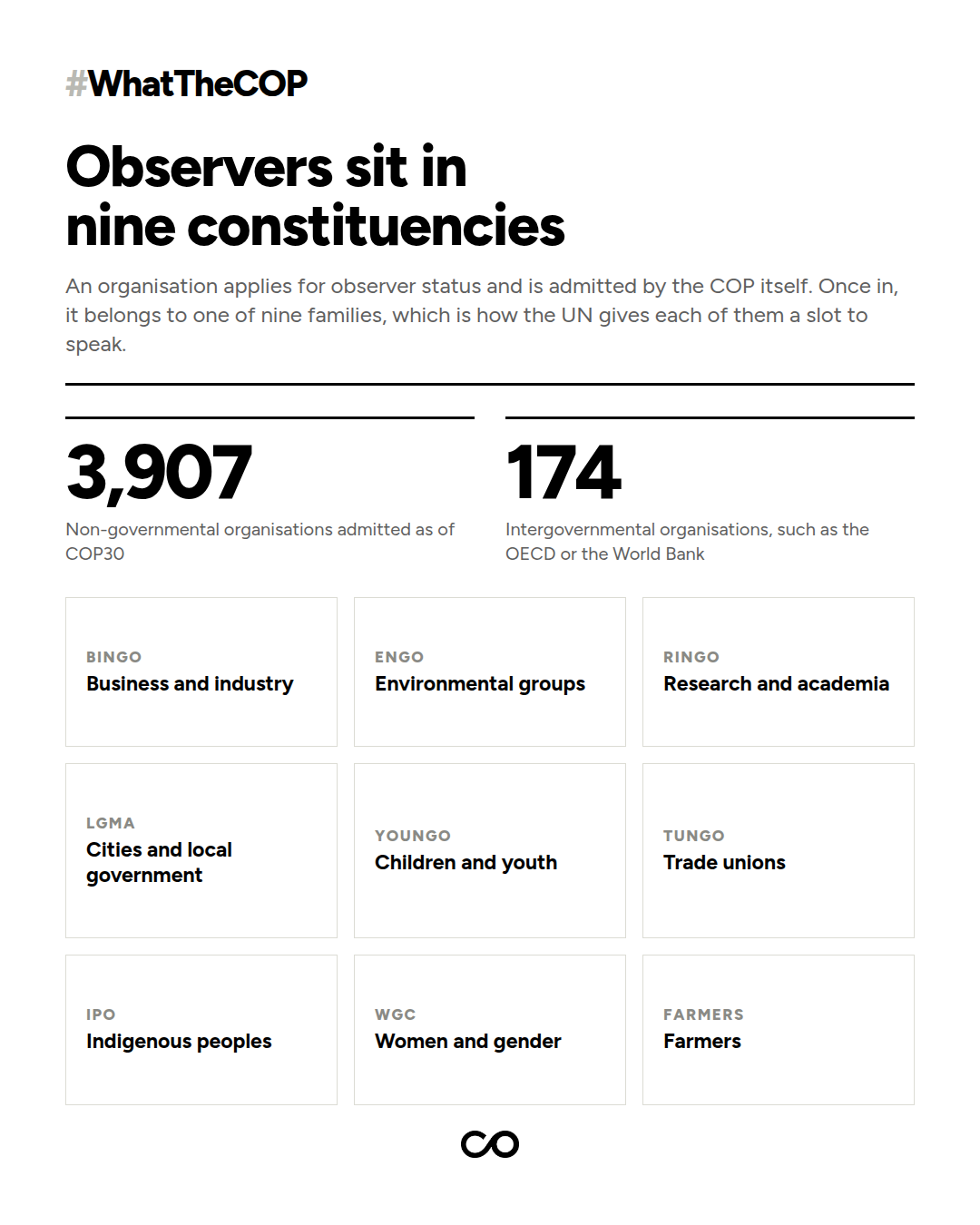
Observers sit in nine constituencies
3,907 NGOs and 174 intergovernmental organisations were admitted to COP30. Observers are sorted into nine groups: business and industry, environmental, research and academia, local governments, children and youth, trade unions, indigenous peoples, women and gender, and farmers.
The High-Level Champions
There are always two, one appointed by each of the last two presidencies, and the role was created by the Paris Agreement in 2015. Dan Ioschpe holds it for Brazil (COP30) and Samed Ağırbaş was appointed by Türkiye in April for COP31. The job is to connect governments with companies, cities, regions and investors, to run the Action Agenda, and to carry the presidency's priorities through the whole year.
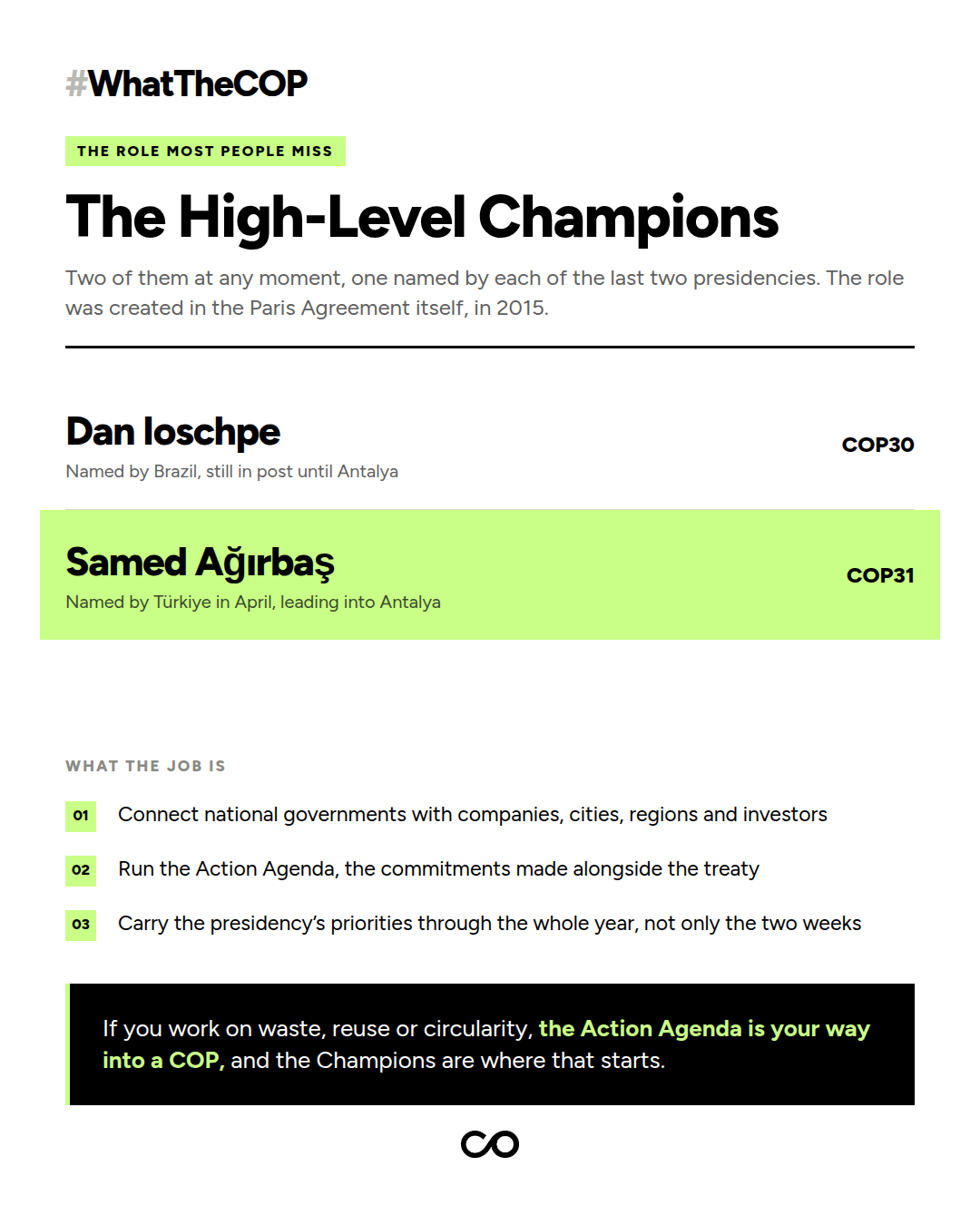
If you work on waste, reuse or circularity, that second space is your way in.
- Presidency
- The country that hosts and chairs a COP. Türkiye for COP31, with Australia chairing the negotiations.
- Secretariat
- UN Climate Change, the permanent staff in Bonn who run the process between COPs.
- Observer
- An admitted organisation that can send delegates without being a government.
- Constituency
- One of nine groups observers are sorted into, each with a focal point to the process.
- AOSIS
- Alliance of Small Island States, 39 members.
- AILAC
- Independent Association of Latin America and the Caribbean, 8 members.