What is a Climate Champion?
A Climate High-Level Champion connects the 198 countries negotiating at a COP with everyone who is not a country: companies, cities, regions, investors, universities, foundations. Two are in post at any time, each appointed by an incoming presidency for two years and overlapping by a year, and what they run is the Action Agenda, not the negotiation. Nothing they ask for is binding, so the job runs on persuasion.
The first time I saw the title Climate High-Level Champion I read it twice. In Spanish, campeón is someone who won something, and in English the word still carries the sound of a podium. It is being used in its older sense, the person who takes up a cause and pushes it.
Where the role comes from
The role was created by the same Paris decision that produced the Paris Agreement in 2015. Countries had just committed to their own national plans, and it was already obvious that those plans alone would not close the gap. Someone had to bring in everyone who is not a country.
So the decision created two High-Level Champions. Each one is appointed by an incoming presidency and serves two years, which means there are always two in post, overlapping by a year.
The first pair, in 2016, were Laurence Tubiana for France and Hakima El Haite for Morocco. Tubiana had been one of the architects of the Paris Agreement itself.
What the job actually is
A Champion sits between the Parties, which is the formal name for the 198 countries in the negotiation, and everybody else: companies, cities, regions, investors, universities, cooperatives, foundations. The negotiation is closed to those actors. The Action Agenda is not, and the Champions are the ones who run it. I went through how that agenda is organised, with its six Axes and thirty Activation Groups, in the newsletter edition on the Action Agenda.
In practice the job looks like an ambassadorship. A Champion spends the year travelling, convening and asking people for commitments that no treaty obliges them to make. Regional climate weeks, ministerial meetings, sector coalitions, board rooms, city halls. Nothing a Champion asks for is binding, so the whole job runs on persuasion.
Who actually does the work
Champions change every two years and presidencies change every year. The Climate Champions Team is the part that does not change. It is the standing team that works to both Champions at once, and it carries the Action Agenda across every handover: the Axes and the Activation Groups, the Plans to Accelerate Solutions, the register of commitments, and the relationships with the thousands of companies, cities and organisations that have signed up to something.
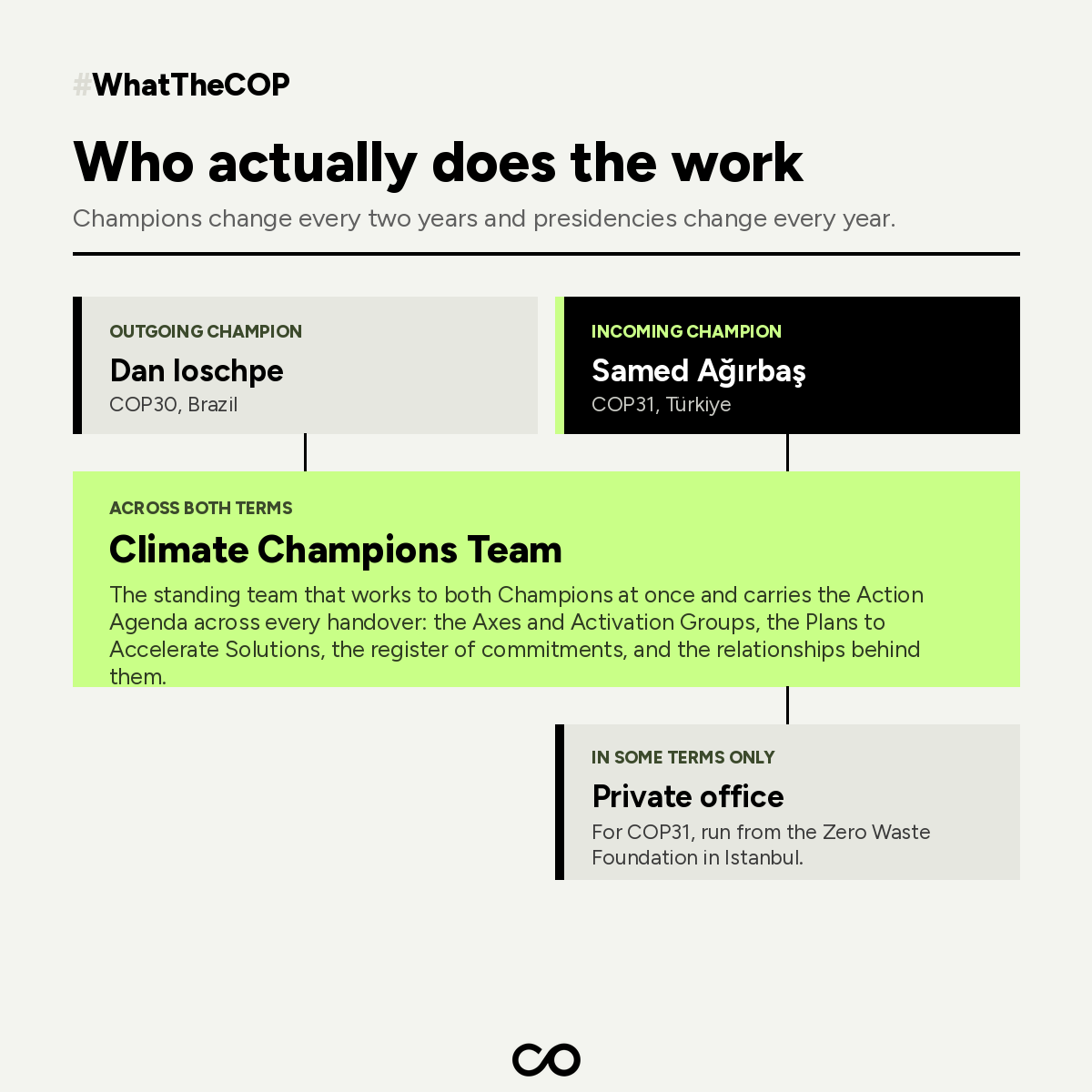
A Champion has two years. The things the Action Agenda is trying to move take longer than that: an industrial transition, a city programme, a reuse system across a supply chain. The team is what lets a commitment made under one Champion still have an owner three Champions later, and what stops each new appointment from starting the agenda again from the beginning.
Some Champions also set up a private office of their own, closer to the presidency and to the host country. COP31 has one, run from the Zero Waste Foundation in Istanbul. I am one of its advisors, with Neil Khor, Carlos Silva Filho, Chris Mensah, Atif Ikram Butt, Pelinsu Colak and Etkin Aktas.
The ten people who have held it
Laurence Tubiana, France, COP21. Hakima El Haite, Morocco, COP22. Inia Seruiratu, Fiji, COP23. Tomasz Chruszczow, Poland, COP24. Gonzalo Muñoz, Chile, COP25. Nigel Topping, United Kingdom, COP26. Mahmoud Mohieldin, Egypt, COP27. Razan Al Mubarak, United Arab Emirates, COP28. Nigar Arpadarai, Azerbaijan, COP29. Dan Ioschpe, Brazil, COP30.
Two who shaped the job before this one
Laurence Tubiana took the post when there was nothing yet to run. In 2016 there was no Action Agenda, only a line in a decision text. What came out of that first year was the Marrakech Partnership for Global Climate Action (launched at COP22 in Marrakech in 2016, which is where the name comes from, and still the framework that organises how everyone who is not a country works alongside those who are), which every Champion has worked inside since, and a public portal where commitments from non-state actors are registered.
Dan Ioschpe holds the post now, and under his term the Action Agenda was reorganised into the six Axes, the thirty objectives and the Plans to Accelerate Solutions that I described last week (thank you for that, Dan, the whole thing is a lot easier to explain now), and more than 120 of those plans were published at COP30 in Belém. He is still in post alongside the new Champion, which is how the overlap is supposed to work.
Samed Ağırbaş, the Champion for Antalya
Murat Kurum, Türkiye's Minister of Environment, Urbanisation and Climate Change and the COP31 President-Designate, appointed Samed Ağırbaş on 24 January 2026. Ağırbaş chairs the Zero Waste Foundation and presides over the Zero Waste Forum in Istanbul. Before that he worked at UN-Habitat and led the Istanbul Youth Assembly.
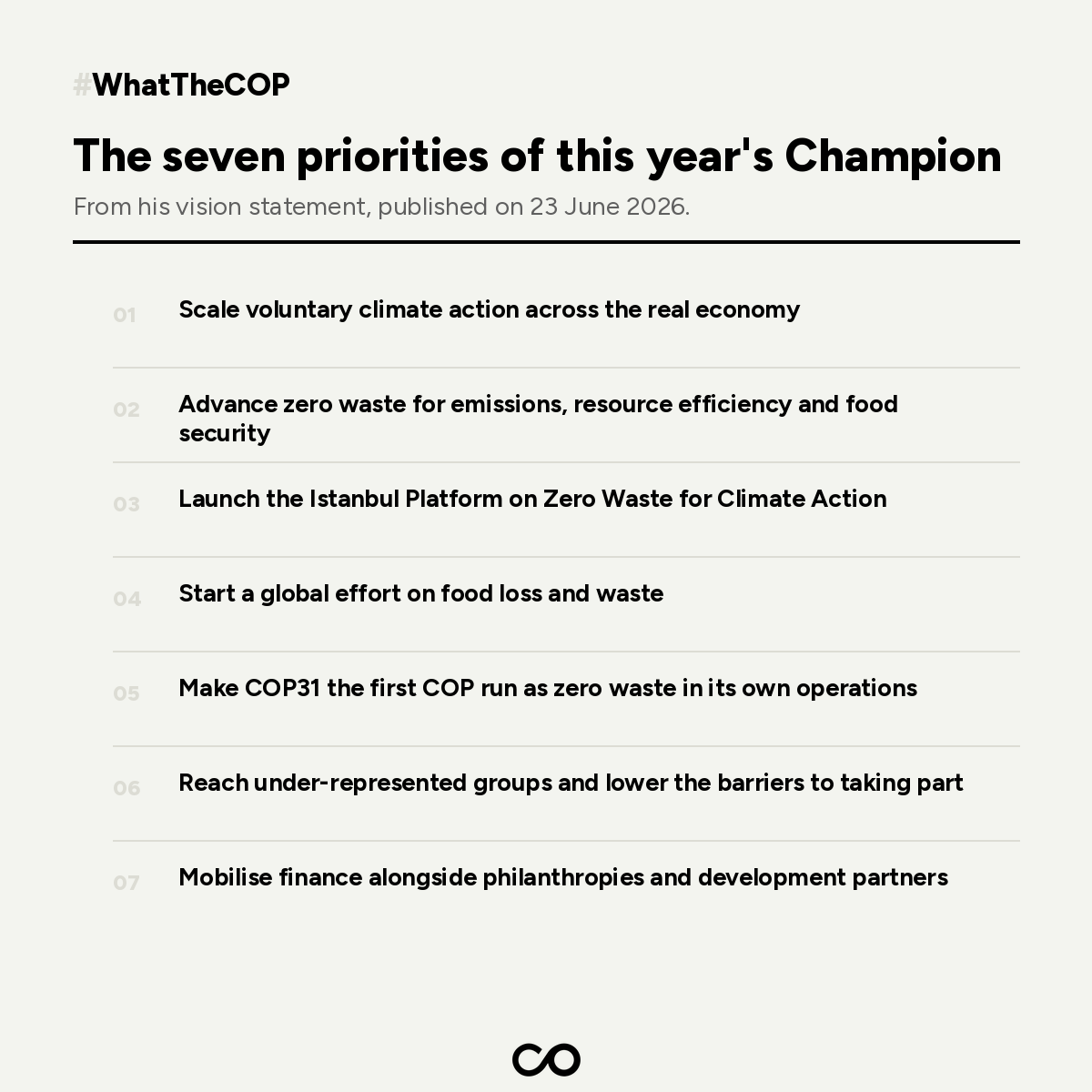
His vision statement, published on 23 June, sets out what he intends to do with the two years:
- Scale voluntary climate action across the real economy, with governments and non-state actors in the same room.
- Advance zero waste as a route to lower emissions, better resource efficiency and stronger food security.
- Launch the Istanbul Platform on Zero Waste for Climate Action, which I went through last week.
- Start a global effort on food loss and waste across cities, communities and value chains.
- Make COP31 the first COP run as zero waste in its own design, management and operations.
- Reach under-represented groups and lower the barriers to taking part.
- Mobilise finance and investment alongside philanthropies, development partners and financial institutions.
Zero Waste Districts works that same agenda at the scale of a city district, with targets of 70% diversion from landfill by 2030 and 90% by 2040, and Mexico City, Kisumu and Penang among the first cities. I work on that one, and it gets an edition of its own later in this series.
The statement keeps returning to one idea, that climate action must improve lives. He argues that solutions work when they are designed with the people they are meant to serve, and he is explicit about how he wants to be judged. He puts the measure of success in whether children are safer, communities more resilient, fewer people hungry and businesses moving faster, ahead of the number of declarations adopted.
What a Champion does during the two weeks
While the negotiators are in their rooms, the Champions are running the other half of the conference. The twelve thematic days belong to the Action Agenda, and the Champions shape what each of them carries: which coalitions get the stage, which plans are launched, which commitments are announced and which turn out not to be ready. They convene the high-level sessions where the year of work with non-Party actors is reported back to the COP, and the rest of the time they are moving between pavilions and bilaterals doing what they have done all year, in a smaller space and with everyone in the same building.
For COP31 that puts Ağırbaş in an unusual position, because the subject he was appointed for is also the subject of the conference. The zero waste day is 11 November, which is day one of the Leaders Summit, so his theme lands on the day the heads of state are in the room. The Istanbul Platform is his flagship initiative and it needs members by then. The Upstream Plan to Accelerate Solutions has its official launch at the COP. And the commitment to run the conference itself as a zero waste event is the one thing on his list that anyone walking the venue can check.
The job does not end in Antalya
A two-year term means Ağırbaş is only halfway through when Antalya finishes. He spends 2026 working with Türkiye and Australia, and he spends 2027 working with the next presidency, which will be Ethiopia, in Addis Ababa.
The Champion who put zero waste on this agenda is still in post for the whole year that follows, and the Global Climate Action Agenda he is working to runs on a five-year horizon rather than a conference-sized one.