Zero waste finally gets a seat at a COP
The Istanbul Platform treats zero waste as something that runs across all six Axes of the Action Agenda instead of sitting inside one of them. The Upstream Plan to Accelerate Solutions gives reuse and repair a formal place in the climate agenda for the first time, with its official launch at the COP.
COP31 puts waste at the centre of a COP for the first time. Zero waste has its own day, 11 November, and it is the same day the Leaders Summit opens, so the heads of state are in the building.
What changed is not only that the subject got a day. It got a place in how the whole agenda is organised.
Ten priority themes
The COP31 presidency runs its Action Agenda on ten priority themes. One of them is Zero Waste and Methane Reduction. Another, Green Industrialization, carries the circularity target.
That list sits alongside the six Axes and thirty Activation Groups I went through in the edition on how the Action Agenda is organised. The Axes belong to the process and carry over from one COP to the next. The ten themes are where this presidency has chosen to spend its attention between now and November.
The targets, and what each one has to do with waste
Four numbers, all for 2035.
Electricity: raise the share of final energy demand met by electricity from just over 20% today to 35%. Less waste in the system to begin with, because an electrified process wastes less energy than a combustion one.
Waste: cut by at least 50% the projected increase in global annual municipal solid waste generation. I went through this one last week.
Buildings: cut energy consumption intensity in the building sector by at least 25%. Construction and demolition is one of the largest waste streams in the world, and it barely appears in the conversation.
Circular material use: raise the global rate from 6.9% today to at least 15%. This is the figure I said last week I could not confirm. The presidency''s third letter to Parties has it, under Green Industrialization.
And methane runs underneath all of it. The presidency cites UNEP''s Global Methane Assessment, which attributes around 30% of current global warming to methane, and waste is one of its three big sources. That is why methane and zero waste share a theme, and share 11 November.
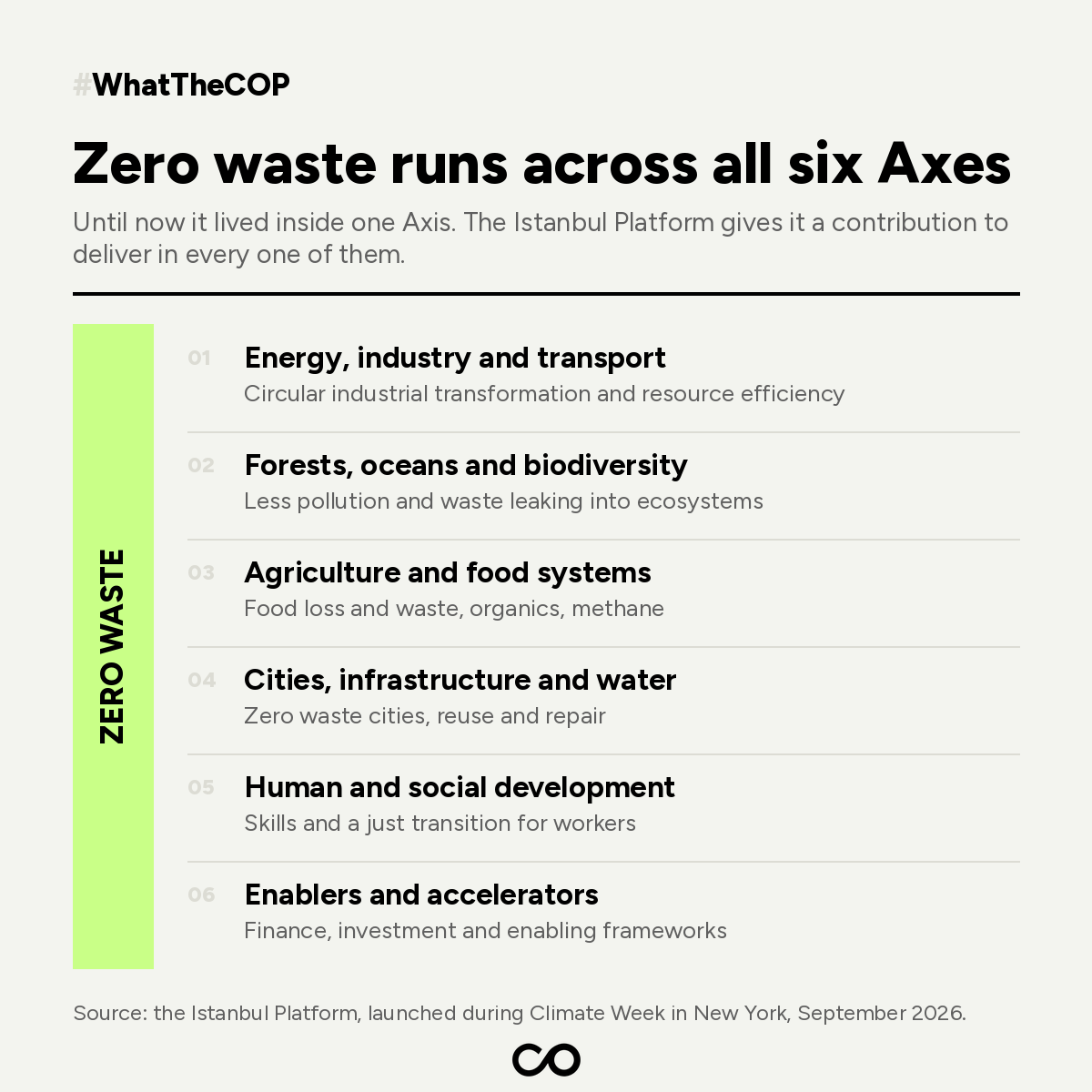
The Istanbul Platform
The Istanbul Platform is the biggest change in this COP for anyone working on waste, and it was launched during Climate Week in New York in September. Its stated goal is to connect what already exists, maximise its impact, and give it the visibility and political momentum needed to scale.
Until now, zero waste and circularity were treated as one subject among many, sitting in the part of the agenda about cities or about waste management. The Platform treats them as something that runs across all six Axes of the Global Climate Action Agenda at once:
- Energy, industry and transport: circular industrial transformation and resource efficiency.
- Forests, oceans and biodiversity: reduced pollution and waste leakage into ecosystems.
- Agriculture and food systems: food loss and waste reduction, organics and methane mitigation.
- Cities, infrastructure and water: zero waste and resilient cities, reuse and repair.
- Human and social development: skills and a just transition for workers and communities.
- Enablers and accelerators: finance, investment and enabling frameworks.
Zero waste stops being a sector with its own corner and becomes a way of delivering across the whole agenda.
The Platform commits to five things: advancing solutions that respond to the Global Stocktake (the periodic review where countries assess collective progress under the Paris Agreement), connecting delivery across Activation Groups and Plans to Accelerate Solutions, giving ready-to-scale solutions visibility and filling the gaps in delivery, measuring the contribution of solutions as they expand, and building coalitions that carry forward between successive COPs.
There is no member list published yet, no governance document and no quantified commitments by actor. Anyone quoting you a membership figure for the Istanbul Platform is ahead of the public record.
The Upstream Plan to Accelerate Solutions
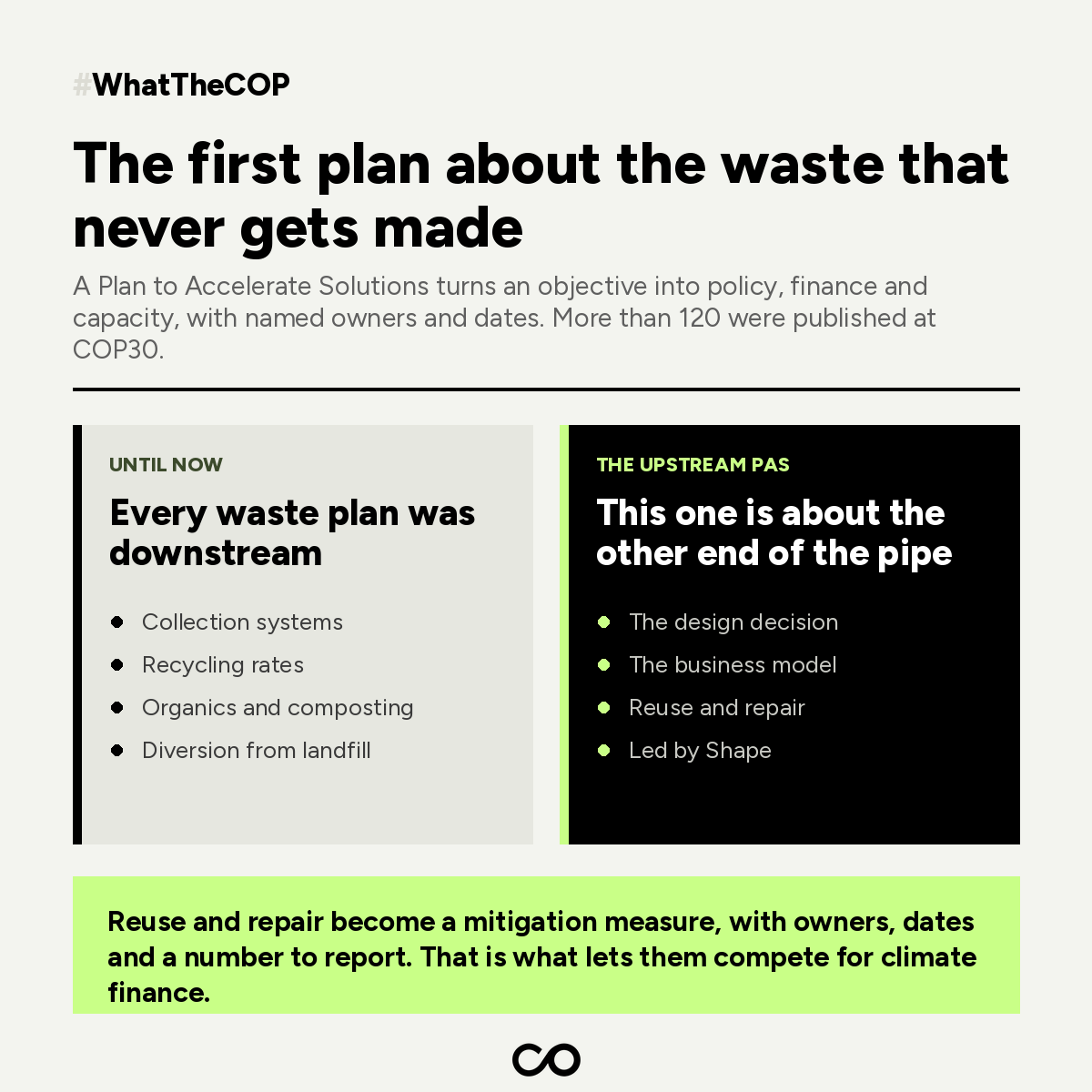
A Plan to Accelerate Solutions is the format the Action Agenda uses to turn an objective into something deliverable: policy, finance and capacity around one solution, with named owners and dates. More than 120 were published at COP30.
The Upstream PAS was presented during that same New York week, and the official launch is at the COP. It is the one I have been waiting for. It is led by Shape, where Joan Marc Simon, formerly of Zero Waste Europe, is CEO and Joe Papineschi is chairman.
Every plan in the Action Agenda that has touched waste until now has been about what happens to material once it already exists. Collection systems, recycling rates, organics, diversion from landfill. All of it necessary, and all of it downstream of the decision that created the waste.
This plan formalises the other end of the pipe. Its subject is the design decision, the business model and the repair that stop material from becoming waste at all. Avoiding waste has been an argument people in my field have been making for twenty years, and in Antalya it gets a formal instrument inside the climate agenda.
What that gives reuse and repair is a seat. Until now they have been treated in climate conversations as a consumer habit or a nice gesture, the kind of thing that goes in the final slide. Inside a Plan to Accelerate Solutions they are a mitigation measure, with owners and dates, and they have to demonstrate their contribution to emissions reduction like everything else in the room.
It also changes where the money can come from, because a reuse or repair system that can report tonnes of CO2 avoided is competing for climate finance rather than for a sustainability budget, and those are different orders of magnitude.
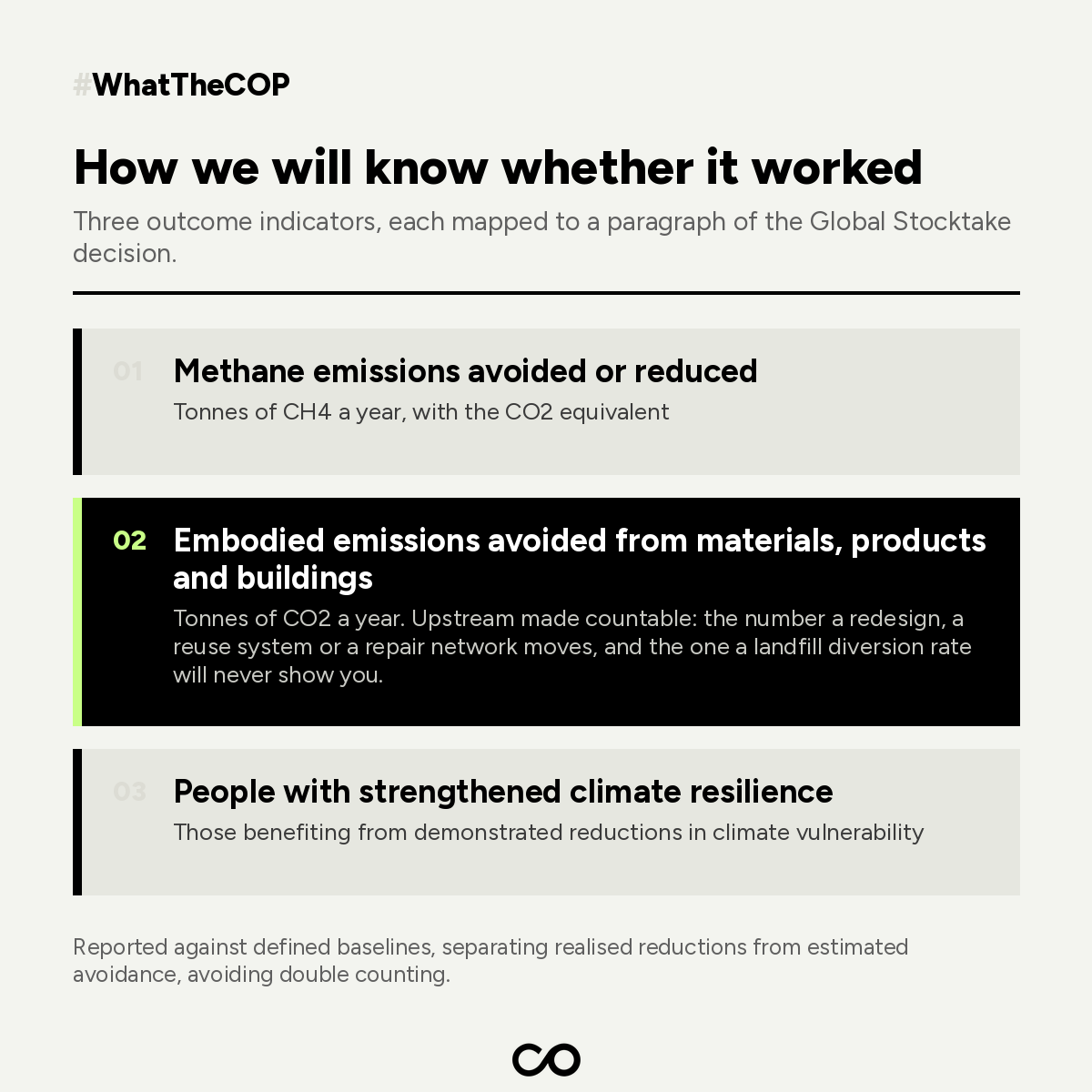
How we will know whether any of it worked
Most initiatives at a COP are announced without a way of telling, a year later, whether they did anything. The Platform has a measurement framework, and it is tied to the Global Stocktake decision.
Three outcome indicators. Methane emissions avoided or reduced, in tonnes of CH4 a year with the CO2 equivalent. Embodied greenhouse gas emissions avoided or reduced from materials, products and buildings, in tonnes of CO2 a year. And the number of people with strengthened climate resilience, measured as those benefiting from demonstrated reductions in climate vulnerability. Each one is mapped to a specific paragraph of the Stocktake decision.
The second of those is the one I care about most. Embodied emissions from materials, products and buildings is upstream made countable. It is the number that a redesign, a reuse system or a repair network moves, and the one that a landfill diversion rate will never show you.
There is also a methodological note I did not expect to find: report against defined baselines, separate realised reductions from estimated avoidance and potential, and avoid double counting. That discipline is not standard in this kind of initiative.
A COP that is trying to run itself as zero waste
The presidency is putting real effort into COP31 being run as a zero waste event: catering, materials, signage, what happens to everything once tens of thousands of people leave Antalya.
I am not expecting perfection, and a conference of this size will always generate waste. What is different is the emphasis, and that the people running the operation are being held to the subject they put on the agenda.
The Leaders Summit has a roundtable on circular economy, and the published programme mentions sessions led by Emine Erdoğan on the Zero Waste movement.
What to watch next
The pavilion programmes start going up over the coming weeks, and that is when the agenda for 11 November becomes something you can actually plan around. I am tracking which ones have published at whatthecop.com.
If you want to be in the room, accreditation takes longer than most people expect, and the post on accreditation goes through the four routes.