Who runs COP31, and what they have committed to
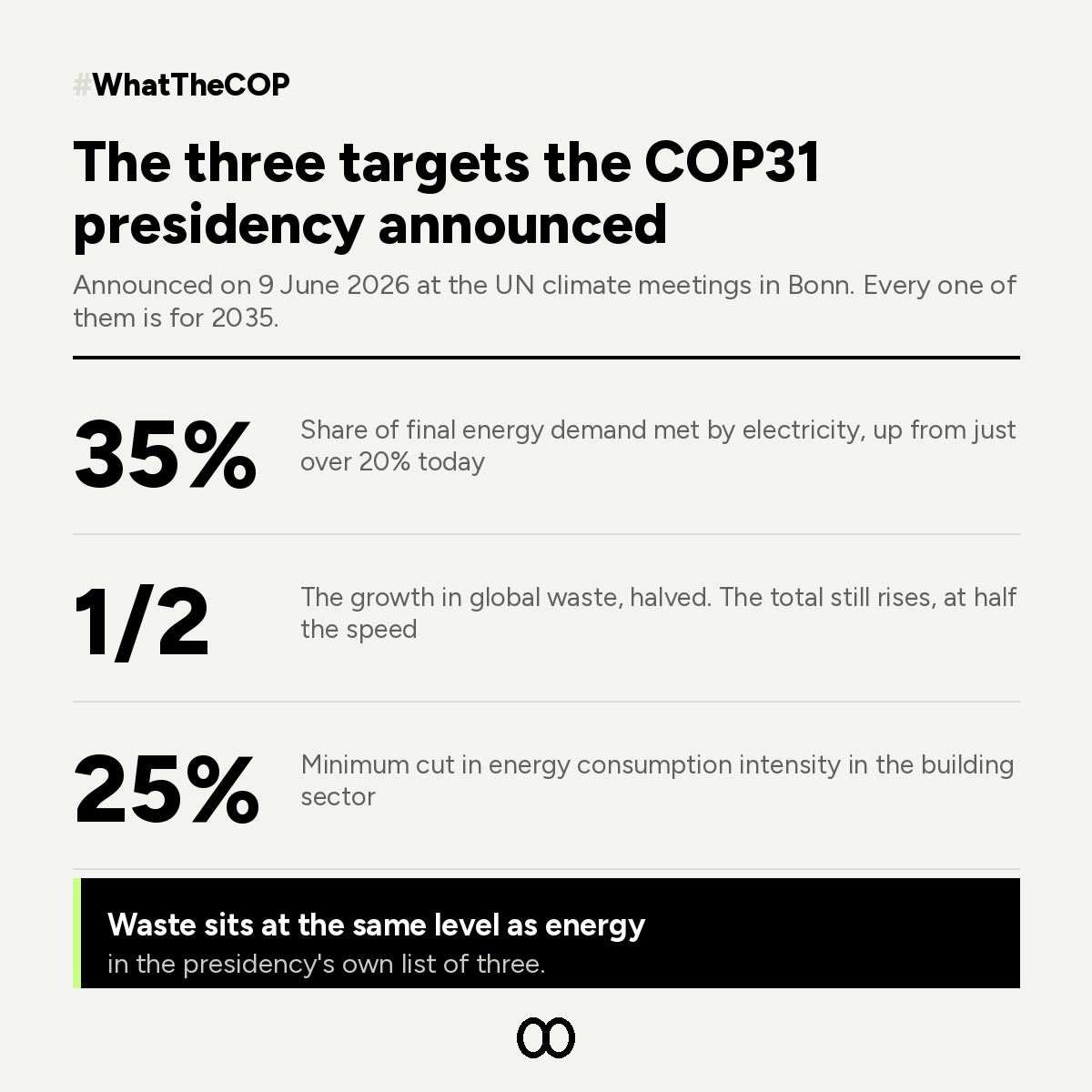
COP31 is shared between two countries. Türkiye holds the presidency, hosts Antalya and has authority over the Action Agenda. Australia leads the negotiations. The presidency has announced three targets for 2035, on electricity, waste and buildings.
COP31 has not even started and it already has something no COP has had before. Two countries are going to share it.
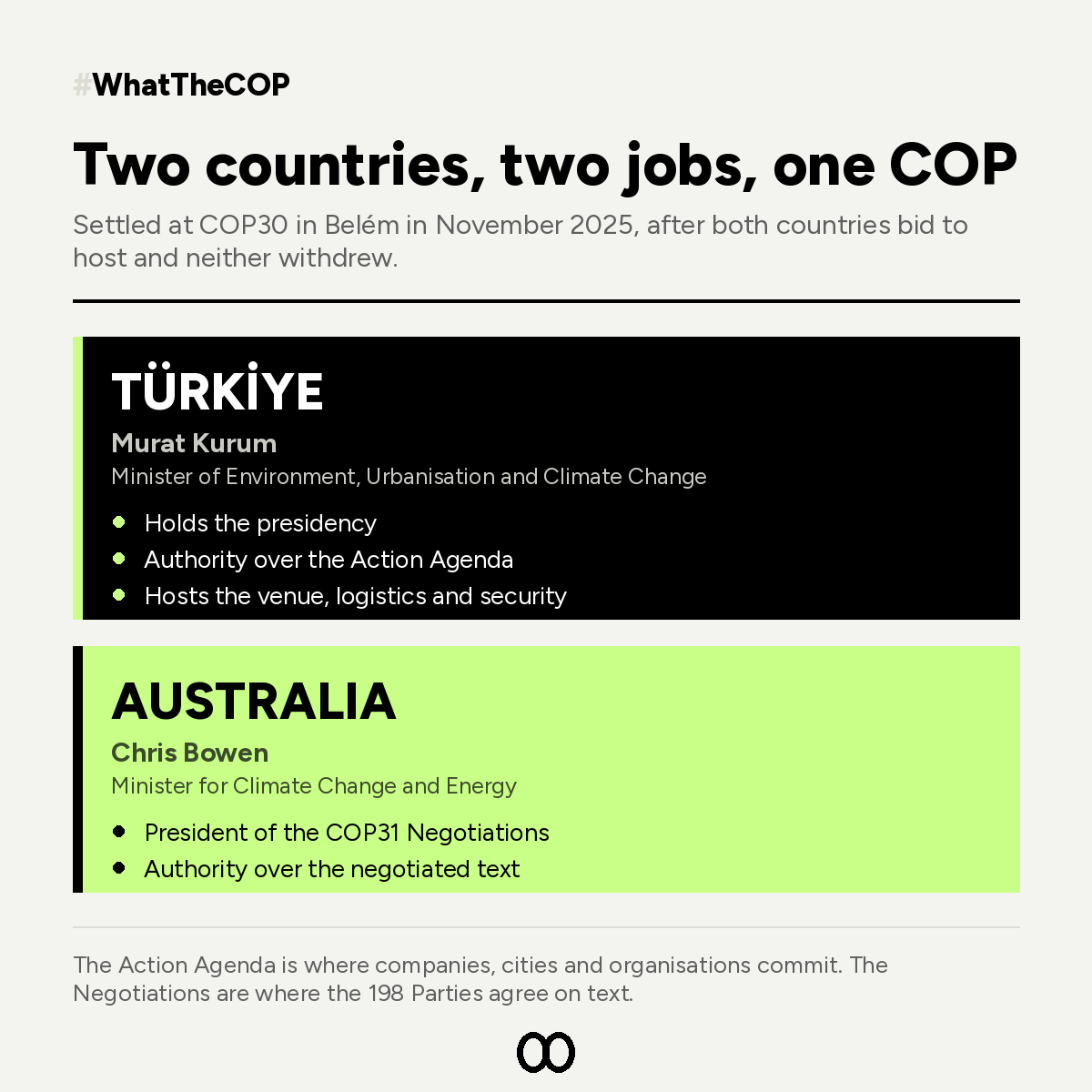
Türkiye holds the presidency and hosts the two weeks in Antalya. Australia leads the negotiations.
The closest thing to a precedent is COP25, when Chile held the presidency and the conference had to be moved to Madrid. Chile still ran the whole thing, Spain provided the venue. This time the presidency and the leadership of the negotiations actually sit in two different capitals, with two different ministers in charge.
And then, on 9 June in Bonn (officially SB64, the mid-year session where the negotiation text gets drafted, and one of the eight stops on the calendar I mapped out in an earlier #WhatTheCOP post), the presidency put numbers on the table. Three targets for 2035, one of them on waste.
Why there are two
The host of a COP is not picked by a vote. It has to be agreed by consensus, which means that any country holding out can stop the decision from being taken at all.
Türkiye and Australia both wanted 2026 and both put in a bid. Neither of them withdrew, and the stalemate ran for months. For a while there was a real possibility of arriving at COP30 without a confirmed host for the following year.
It was settled at COP30 in Belém in November 2025. Australia withdrew its bid to host, and took the leadership of the negotiations instead. Türkiye got the conference, the venue and the presidency. The division of roles at COP31 is the shape that agreement took.
How the two roles divide
Türkiye has authority over the Action Agenda. Australia has authority over the Negotiations.
These are the two tracks that run in parallel at every COP. The Action Agenda is where companies, cities, regions and organisations commit to things, and the newsletter edition on how the Action Agenda is organised goes through its six Axes and thirty Activation Groups. The Negotiations are where the 198 Parties agree on text, and the #WhatTheCOP post on who is who at a COP covers who sits in that room and how the negotiating blocks work.
Türkiye also carries everything that comes with hosting: the venue, the logistics, the security, the operation of the two weeks.
So when you hear that COP31 has two presidents, what is being described is two different jobs. Murat Kurum, Türkiye''s Minister of Environment, Urbanisation and Climate Change, is the COP31 President-Designate (the title a COP president carries until the previous presidency hands over on day one). Chris Bowen is President of the COP31 Negotiations for Australia.
If you want the rest of the roles, that same post on who is who at a COP goes through them, including the High-Level Champions, who are the link between the two tracks.
The three targets
The presidency put numbers on three things, all of them for 2035:
Electricity. Raising the share of final energy demand met by electricity from just over 20% today to 35% by 2035.
Waste. Halving the growth in global waste by 2035.
Buildings. Reducing energy consumption intensity in the building sector by at least 25% by 2035.
The waste target, and where the real opportunity sits
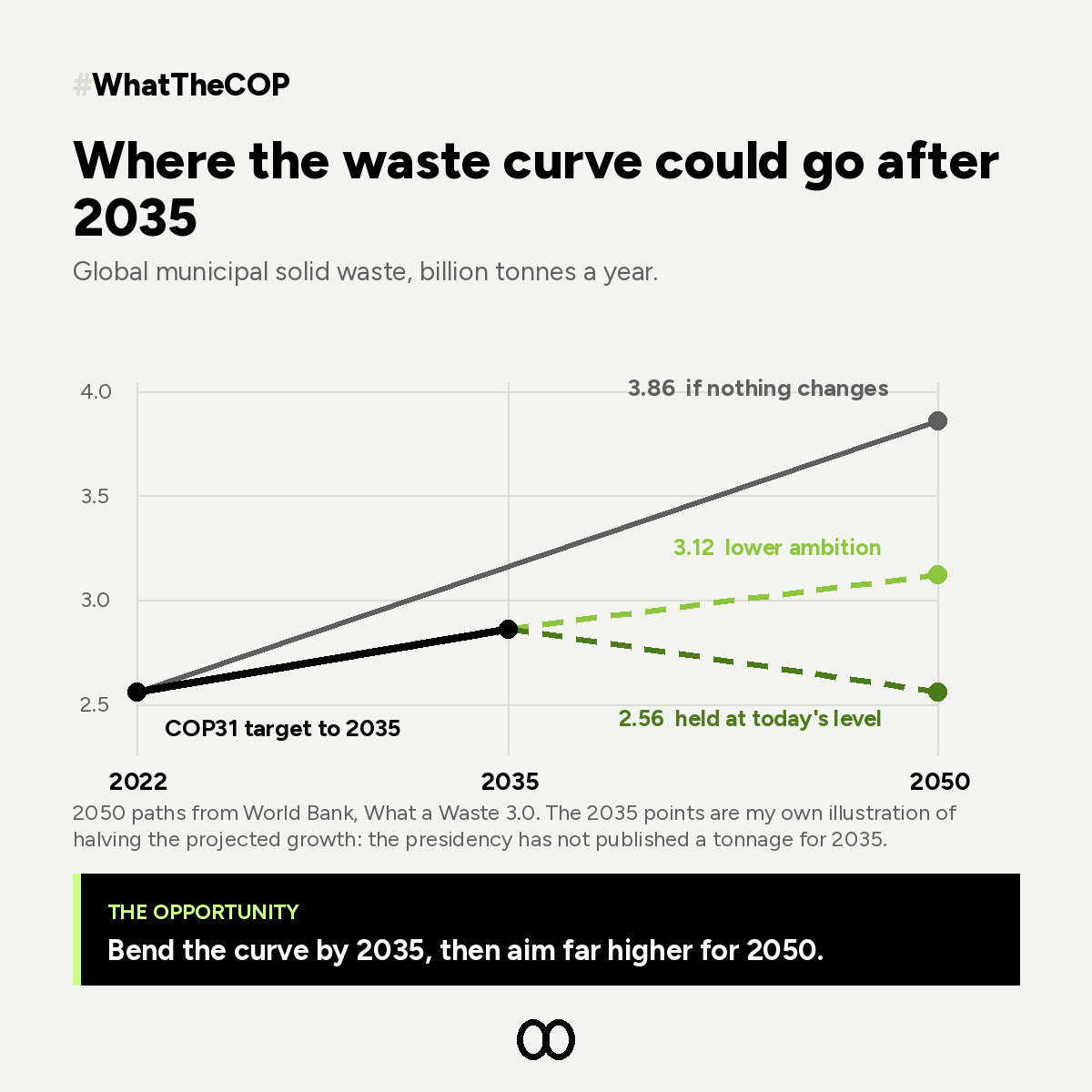
The second one needs reading closely, because the short version going around is "halving global waste", and what the target addresses is the growth.
The World Bank puts global municipal solid waste at 2.56 billion tonnes in 2022, heading for 3.86 billion by 2050 if nothing changes. The way I read the 2035 target is as the first leg of a longer route. If the curve starts bending now, 2050 stops being the year the problem has nearly doubled and becomes a date to aim something much more ambitious at, which is already the horizon most countries use for their net zero commitments.
For me the number matters less than the fact that it exists at all. This is the first time waste has had a headline target at this level, sitting next to energy and buildings.
It is worth being clear about where that came from. A target like this does not appear because a presidency decided waste was an interesting subject. It exists because startups, NGOs, local governments and companies have spent years doing the work: running collection, reuse and refill systems in real neighbourhoods, building composting capacity where there was none, training people, measuring what actually happens to the material, and producing the evidence that makes a conversation at this level possible.
What Türkiye has done is get behind that agenda and scale it. A movement that has been built city by city now has a global target, a day in the Leaders Summit and a presidency carrying it into the room where 198 countries are sitting. The work was already there, and what this COP adds is a platform for it.
And it has been escalating the subject step by step, with the Zero Waste Foundation behind each move. Türkiye proposed the International Day of Zero Waste, which the UN General Assembly adopted in December 2022 and is now marked every 30 March. Then came the Advisory Board of Eminent Persons on Zero Waste, convened for the UN Secretary-General. Then the Zero Waste Forum in Istanbul in June, three days with 5,000 people from 150 countries. The COP31 targets are the next step in that sequence, and Zero Waste has its own day on 11 November, which is also day one of the Leaders Summit.
Which brings me to what I most want to see in Antalya. Almost every waste target in the world is measured at the end of the pipe: how much was collected, how much was recycled, how much went to landfill. Redesigning a product so it needs less material in the first place, putting a package into a reuse system, repairing something instead of replacing it, none of that registers as waste managed, because the waste never came into existence. It is invisible to the metric, and it is the cheapest tonne there is to avoid.
If a 2035 target is going to bend the curve rather than move waste between treatment options, upstream has to be in the discussion. Redesign, reuse and repair are where the biggest reductions are, and they are the part that current accounting does not capture. This is the year to get them in, with a presidency that has already put waste on the table and a Champion who comes from this field.
There is a fourth figure circulating, a circular material use rate of at least 15% by 2035. The presidency''s own page describes it as still being developed, without a number attached.
What the presidency has set in motion
Alongside the targets, two things are worth tracking:
- Special reports commissioned from the International Energy Agency (the IEA, the intergovernmental body that publishes energy data and analysis), by the presidency together with Australia.
- The Climate Implementation Bridge, an initiative to help countries turn their NDCs into project portfolios that investors can actually fund. (NDCs are the climate plans every country submits under the Paris Agreement; there is a longer explanation at whatthecop.com/questions/what-is-an-ndc.)
What I take from it
The three targets show which topics the presidency wants on the table between now and Antalya. The Action Agenda will be organised around them, and the pavilions, sessions and announcements will cluster there. (A pavilion is a space inside the Blue Zone where a country or organisation runs its own two-week programme, covered in the #WhatTheCOP post on the Blue Zone and the Green Zone.)
The practical use of all this is knowing where your own focus belongs. A pilot, a city programme, a reuse system or an industry coalition sits on the Action Agenda side, which Türkiye runs. Work aimed at the treaty text, the funding decisions and what the 198 Parties sign up to sits on the negotiations side, which Australia leads.
And if what you are weighing up is whether to be in Antalya at all, the gate is accreditation, not an invitation. The #WhatTheCOP post on accreditation walks through the four ways in and how long each one takes.